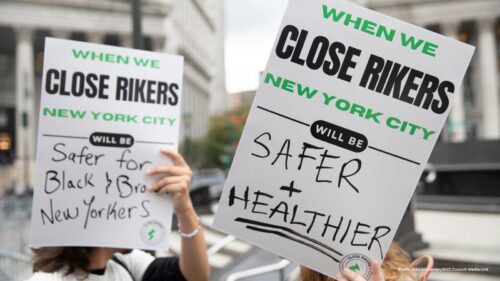
Closing Rikers Island is the only way to ensure dignity and safety for all New Yorkers.
With the recent appointments of federal remediation manager Nicholas Deml to take control of Rikers Island and reformer Stanley Richards to lead the city’s Department of Corrections, New York City has a decisive opportunity to address the human crisis at the jail complex.
For decades, the jails on Rikers Island have been notorious for inhumane conditions and widespread violence. Last year alone, 15 people died during or shortly after their detention in New York City’s jail system. Many people detained on Rikers haven’t been convicted of the crime they’ve been charged with. And the majority of people there—both incarcerated people and those who work in the jails—are Black or Latino.
With their decades of experience, Deml and Richards are well-positioned to advance solutions that can protect the safety and well-being of those in jail. Yet the only way to ensure dignity and safety for all New Yorkers is to close Rikers Island for good.
The path forward is complex, but clear. Our CEO Courtney Bryan has served on the independent commissions tasked with outlining concrete steps to safely close Rikers Island. The Independent Rikers Commission’s roadmap reflects years of research and the insights of countless practitioners, reformers, and people with firsthand experience in the jails.
Reducing the number of people held in jail
Finally closing Rikers Island will require significantly reducing the number of people held in jail in New York City. Doing so means investing in meaningful alternatives, from programs that offer treatment instead of incarceration to community-based supervision for people awaiting trial.
If safely and substantially reducing the jail population seems like a daunting task, we know that it has worked before. At the height of the COVID-19 pandemic, New York City’s Early Release Program helped get hundreds of people out of jail with high rates of compliance and few rearrests. And our recent research adds to a growing body of evidence that jail reduction strategies can strengthen public safety.
These tools have shown high success rates and have the potential to be used more widely. Commissioner Richards should maximize the use of his authority under Article 6A to help people serving jail sentences return to the community with the support and supervision they need to stay out of the system.
Since reducing the jail population is critical to maintaining safe jails, the new remediation manager should also be empowered to consider similar measures to expand alternatives to pretrial detention, especially for people with serious mental illness. Finally, city agencies must work together to ensure court cases move through the system in a timely manner, addressing backlogs that can leave people languishing in jail.
Expanding access to transitional and supportive housing
22 percent of the roughly 7,000 New Yorkers in jail have been diagnosed with a serious mental illness. As the city’s jail population has increased in recent years, so has the share of incarcerated people with mental health and substance use needs. On top of that, nearly a third of New Yorkers in jail are either homeless or at risk of homelessness.
For those reasons, reducing the jail population goes hand-in-hand with investing in a broad spectrum of housing alternatives for people with serious mental illness. New Yorkers facing these challenges need a continuum of programs that combine affordable housing with on-site mental and behavioral health services, especially for people who have been involved in the justice system.
Without an adequate supply of transitional and supportive housing beds, judges often see jail as the only safe option. Increasing investment in these programs would give judges more confidence in prioritizing community-based alternatives. Just as importantly, it would put people struggling to access care on a path to a more stable future.
Investing in reentry services
Last but not least, New Yorkers returning from incarceration must receive the support and resources they need to succeed in their communities. Expanding access to those resources is critical in order to prevent justice involvement from becoming a vicious cycle.
Even a brief encounter with the justice system can negatively impact a person’s employment, housing, and immigration status. That compounds the pre-existing challenges, like poverty and housing insecurity, that many people already faced before their arrest. All of those issues make it more likely that someone will come into contact with the system again.
Reducing the number of people in jail is a crucial step, but it isn’t enough by itself. For those changes to be sustainable, people returning home also need support to get back on their feet—or even find the basic stability they may never have received in the first place. And that means providing reentry planning to connect people to housing, trauma-informed care, employment resources, and other services they need to thrive.
As our CEO Courtney Bryan wrote in an op-ed for City & State last year, “closing Rikers is the only way to permanently disrupt the cycle of violence and the culture of complacency that allows that violence to persist.” As Nicholas Deml and Stanley Richards take on the immediate challenge of addressing the unacceptable conditions in the jail complex, everyone involved can and must work together to make that goal a reality.