A conversation with Shamilia Tocruray, Director of Education at the Brooklyn Museum, on the intersection of arts and justice.
For people charged with low-level offenses, even a minor encounter with the justice system can do lasting harm.
Project Reset works to change that. Instead of court and a criminal record, participants take part in brief, restorative programming in their community.

In some cases, that can mean a visit to the Brooklyn Museum. Project Reset partners with the museum to offer people a unique—and more vibrant—pathway out of the justice system, one that aims to spark reflection and connection.
Shamilia McBean Tocruray, Director of Education at the Brooklyn Museum, joined us to talk about the power of this unlikely partnership—and how art can serve as a vehicle for contemplation, community, and social change.
Can you talk a little about Brooklyn Museum’s work with people involved in the justice system through Project Reset—what does that look like?
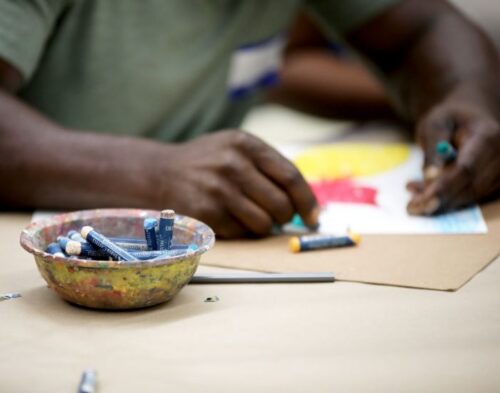
We actually just crossed over the five year threshold of this partnership. Folks welcomed in by Project Reset come to the Museum and have an opportunity to really be in connection with art and to be in dialogue about what’s coming up for them as humans in response. They also get to spend time in studio practice, creating art themselves.
…more about our shared humanity and less about what happened.
By the end of the experience, they’re able to sidestep being involved with court and hopefully minimize relationships with the carceral system.
Something that feels important to me is that a participant walking in could be holding so much tension—like, “What am I going to have to do or explain about myself?” And the focus in these workshops is not what you did or didn’t do. It’s actually more about what this art is offering up for you as a human being. So more about our shared humanity and less about what happened.
How does the museum create a space that feels different from court for participants?
It’s like night and day to me. This space is really designed for people to be in discovery and contemplation. It’s a space of community, playfulness, joy—which feels like the direct opposite of the punitive notion of a court or carceral space. So it feels like a useful and generative way to address what this person might have been working through and to move it off of their plate.
A low-level offense can end up requiring a lot of administration to navigate through, even though it doesn’t need to be such a heavy lift. If there’s going to be a lift, having it be a generative one that connects you to the resources and spaces available in your community feels like a better use of time and energy than navigating the bureaucracy of the court system to get this cleared. And sidestepping going to court altogether is an opportunity to distance ourselves from the carceral system and hopefully minimize instances of contact with that going forward.
At the Center, we work with many people who may have engaged in harm but who have also experienced lots of harm themselves, both interpersonal and systemic. What role do you think art can play in addressing those harms?
Art has this unique, fluid quality that allows for it to have something for everyone. Its potential for a restorative and healing quality is really heightened because there’s no wrong answer. The art has no judgment for you. And that means that being with it, making it, and discussing what comes out of it for you can offer up a mirror—perhaps to process harm, perhaps to process reconciliation, perhaps to think across difference.
If I show you a work of art, what you see is going to be different than what I see. And that offers up an opportunity for us to have a conversation about what we see differently. It gives us a chance to sit in our expertise around our own experiences, and sometimes a springboard to have conversations that we wouldn’t get to. It offers up an aesthetic distance that gives us protection to explore things that might be a bit more sensitive or that we typically wouldn’t want to go into.
Many participants reflect on living in Brooklyn their entire lives but never visiting the Brooklyn Museum. How do you think about inclusion for people who may not typically see museums as spaces for them?
In our education department, that’s really the thing that’s on our mind every day. In any space where we’re curating an education, we’re beginning with participant voices when they come through the doors. We’re asking, “What are your first reactions? How does this make you feel?”—starting there before giving input or context about something we’re observing together.
That’s part of a liberatory approach to education, which is rooted in the scholarship of Paulo Freire and bell hooks and other folks who talk about education as a space for creating the self and building out the world that we want to see.
The arts have always been vehicles for public speech and for questioning systems that we want to shift.
Something else we’ve been working on is breaking up this notion of the “hallowed halls.” Museums in general can feel inaccessible, like you need to be an art historian or be super silent and familiar with the material. And that couldn’t be further from the truth. A piece of art has something for everyone. This is a place for everybody—whether it’s through Project Reset or one of our public programs, there is a space to come in and be with one another here.
How do you think justice and the arts are intertwined?
I don’t see a separation. I found my way to this work thinking about how arts-based practice intersects with social justice. The arts have always been vehicles for public speech and for questioning systems that we want to shift.
Art has this quality that suspends some of our defensiveness and judgment. There’s oftentimes this neutrality in the process of interpreting or feeling or creating that makes room for new ways of considering the world, new ways of seeing one another and ourselves. For me, it feels like one of the most effective tools to invite conversations that many of us want to have and don’t know how to approach.
So when we’re thinking about justice—when we’re thinking about the things that we want to work towards and the ways that we want our communities to look—art ends up being this fantastic tool. It can take away some of the burden of these difficult conversations and make room for new ways of being, thinking, and connecting across difference.