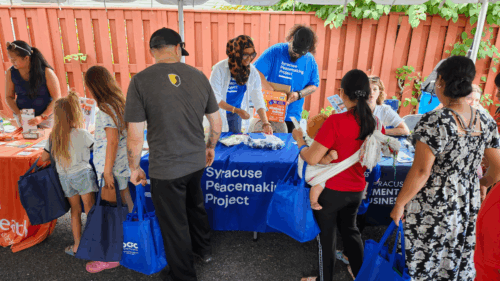
Amid a housing crisis that has left many feeling helpless, the Community Ambassadors program in Syracuse restores communication and trust.
In Syracuse, New York, many families are feeling the effects of a serious, persisting housing crisis.
In recent years, that crisis has become more acute. As many struggle to pay their rent, a shortage of quality housing leaves tenants with few other places to turn. Homelessness has more than doubled in Central New York since 2019, with especially high rates in Onondaga County. Meanwhile, many residents face unsafe conditions in units that stand in desperate need of repairs.
In the midst of these challenges, outreach teams with the Community Ambassadors program are supporting their neighbors in a unique way.
Over the past five years, Syracuse’s Community Ambassadors have worked to keep tenants and small homeowners safely housed. They do that by serving as a bridge between tenants, landlords, homeowners, and city agencies amid widespread breakdowns in communication.
Housing, health, and safety
Housing insecurity has broad impacts on the health of individuals and families. Lack of safe, quality housing can increase the likelihood of illnesses, exacerbate underlying health conditions, and lead to lower life expectancy. Meanwhile, inequality in access to housing contributes to racial disparities in health outcomes and exposure to environmental risks like air pollution and lead.
Many of the residents our Community Ambassadors work with face other challenges that make them especially vulnerable to these harms, from severe poverty to chronic health issues.
The housing crisis also hurts community safety. People struggling to secure safe, affordable housing are more likely to come into contact with the justice system. A criminal record, in turn, creates more barriers to finding stable housing, leading to a vicious cycle.
Meanwhile, high turnover rates in apartments caused by housing insecurity disrupt the social fabric of neighborhoods as a whole. People become less likely to know their neighbors, missing out on the sense of community that enhances our feeling of safety. And the need to move frequently disrupts children’s education, making it more likely that they will miss time at school.
A trust-building response
The Community Ambassadors program aims to address these issues proactively by keeping people in the homes they already have, empowering tenants, and helping residents secure much-needed repairs. Ambassadors—many of whom are from the community themselves—use their connections to reach out to people who need support.
When apartments need repairs, our team helps tenants connect with city code enforcement, which inspects properties for health and safety violations. To prevent evictions, they educate tenants about their rights, coach them on how to communicate with landlords, and help them access legal assistance. Ambassadors also support homeowners who are behind on their taxes to prevent foreclosures.
One resident, Celia, is a single mother with two young children living in an apartment complex on Syracuse’s Eastside. Black mold caused by a leak in the bathroom was triggering her 3-year-old daughter’s severe asthma, exacerbating her cough. Celia had reached out to maintenance several times, but nobody came to make a repair.
A Spanish speaker with limited English proficiency, Celia had first met our team in Syracuse through another community program. When she reached out to the Community Ambassadors, they helped her contact building management and explain the urgency of repairing the mold—and the leak that caused it—for her daughter’s health.
Building management agreed to move the family into another unit for a week while repairs were made. But the temporary space was unfurnished and uncomfortable, prompting the Ambassadors to step in again. They reached out to a supervisor at the management company, who agreed to cover costs for a hotel stay instead. After help from a company specializing in safe mold removal, Celia and her children were able to move back into their home.
Even residents with serious housing concerns are often reluctant to seek help from the city due to widespread mistrust. Community Ambassadors work to change that, acting as liaisons for their neighbors. In an atmosphere that leaves many people feeling helpless, the program restores communication and trust.
Since they began their work in 2020, Community Ambassadors have helped more than 1,100 residents stay safely housed. Nearly half reported the program helped them feel more familiar with available housing resources, and 41 percent said they felt more comfortable calling code enforcement. Ambassadors also play a role in shaping local housing policy, informing city agencies about housing conditions and quality-of-life issues.
In Syracuse and across the country, the housing crisis damages the health, safety, and cohesiveness of our communities. The Community Ambassadors program can serve as a model for mending gaps in communication and repairing trust across systems and communities. And it plays a critical role in addressing the effects of this crisis at the local level.