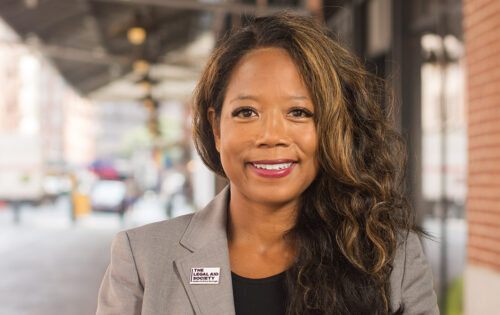
A conversation with Twyla Carter, Attorney-in-Chief and CEO of The Legal Aid Society.
When Twyla Carter started working as a public defender, her mission was simple—to be an advocate for people whose voices had been taken away.
Today, she works as the Attorney-in-Chief and CEO of The Legal Aid Society, the largest and oldest nonprofit law firm in the country. Yet her fundamental mission hasn’t changed.
We met with Twyla Carter for a conversation about her journey in advocacy, the values she brings to her work, and what her career has taught her about what it takes to transform the justice system.
What is The Legal Aid Society, and what did your journey look like leading up to your role as Attorney-in-Chief and CEO there?
The Legal Aid Society is the nation’s oldest and largest nonprofit law firm, providing public defense and civil legal services. We started in 1876 helping German immigrants navigate an unfamiliar legal system. Today, we handle public defense in all five boroughs, as well as over 20 civil lanes—everything from public benefits to immigration, housing, family court, you name it. We also work for systemic change through strategic litigation and our policy work in Albany.
My journey started as a public defender in Seattle, where I worked for over a decade. Then I came to New York and started working on bail reform and systemic litigation around pretrial and right-to-counsel issues as a senior staff attorney at the ACLU National Office. From there I went on to The Bail Project, where I was the national legal and policy director.
I really believe that we have unfortunately criminalized drug misuse, mental health, and poverty, and that we should not be defining people by their worst decisions. All of that experience led me here to be the Attorney-in-Chief and CEO of The Legal Aid Society since 2022. And it’s still a dream job to be able to work alongside our nearly 2,500 staff doing this work on behalf of the people here in New York City.
You’ve done this work from so many different vantage points. How do you think that has influenced the way you think about the issues and solutions in the criminal justice space?
In public defense, you’re doing the work one case at a time, and it allows you to get to know each individual and what led to the situation they’re in. I represented lots of people who were innocent and chose to plead guilty because of bail. We know that there are about 500,000 people in jail across the country on any given night, and roughly 360,000 of them are in on non-violent, low-level crimes because they cannot afford that ransom to get out.
So seeing that and the collateral consequences that flow from a criminal conviction—which makes it harder to get a job, an apartment, or critical benefits—is a lens that I never shed. That’s what led me to the more systemic work, which is about putting ourselves out of business by eliminating the conditions that drive the need for these services.
Nine times out of ten, people who go to prison or jail are coming back into the community. So how do you want them to come back and what do you want to set them up for?
A major priority for me as Attorney-in-Chief and CEO has been making sure that our staff are resourced and well-trained, so that they can do the work on behalf of the people we serve. They come here to help vulnerable and marginalized communities, and it’s truly an honor to support them as they do that work every single day.
You’re also the first Black woman and Asian American to lead The Legal Aid Society. How do you think that shapes the values you bring to this work?
This is who I am, and it is always the lens through which I do the work and through which I move through this country. Culturally, I identify as a Black woman. My father raised my sister and me—we are Black and female, and we have to work three times as hard to prove ourselves. He obviously knew we were half-Chinese, and yet he knew how society would see us because that’s the environment in which we are living.
This experience certainly shapes the values that I bring into the work. One example is anti-Asian hate crime bills. One side of me understands the need for it—I see my mother and my papa, my Gong Gong, in every person on the news who’s been a victim of an anti-Asian hate crime. On the other hand, I know that historically Black people have been asking for a hate crime bill and have never received one, and that hate crime bills often land harder on Black people through implementation and enforcement.
So it’s a lens that I always bring to the work and one that I have to grapple with. And in my role as the first Black woman and Asian American to serve as the Attorney-in-Chief and CEO, I understand just how important culture, identity, and heritage are for our staff and the people that we serve.
What made you want to become a public defender initially?
Growing up, it always felt important to me to be an advocate for the most vulnerable, for people who I felt were voiceless. It wasn’t about saying every human being is a great person, it was about understanding that human beings shouldn’t be defined by their worst decision. Nine times out of ten, people who go to prison or jail are coming back into the community. So how do you want them to come back and what do you want to set them up for?
It was just a common-sense approach to criminal justice and I wanted to be a part of that. All it takes to become the client of a public defender is an accusation and the inability to hire a private lawyer. That’s it. And in my nearly 20 year career, I have never met someone who’s inherently evil. I’ve met a whole bunch of people dealing with the struggles of life, and some are doing it better than others.
What are some of the main challenges you see clients dealing with—not just in the legal system itself, but more broadly outside of their court case?
Most people didn’t just wake up and find themselves in the criminal legal system. There are some telltale signs, because, again, we’ve criminalized drug misuse, mental health, and poverty. The criminal legal system has been used to deal with every societal ill we have. But we know that it’s really about access to services and resources, which is one of the most overlooked parts of this conversation.
Stable housing, meaningful vocational and educational opportunities, access to mental health, substance use treatment—those are the real pathways to avoiding the criminal legal system. And yet too often those services don’t exist, or the people we serve are denied access to them. They’re shut out of alternatives to incarceration, programs that could actually address the underlying issues. If we invested more in off-ramps instead of cages, we would not only improve individual outcomes, but we would strengthen communities and reduce long-term system involvement and its impact on families.
Justice looks like a system that actually meets people where they’re at, that protects their dignity at the moments of their greatest vulnerability.
At the same time, government budgets at all levels reflect values—that’s just a fact. Even if the system is broken or doesn’t work, it is the system by design, and it’s the one that we, the people, ultimately accept.
It’s no secret that the justice system overwhelmingly impacts low-income communities and people of color. What do you think some of the core priorities have to be in order to address those inequities?
First and foremost, we must confront systemic racism head on. We know that communities of color are over-policed and over-surveilled. I’ve seen in my experience as a public defender, for example, that if a white child is caught shoplifting, it’s often their parents who are called. If a Black or Brown child is caught shoplifting, the police are called. So we know that systemic racism exists in the criminal legal system, and confronting that is the only way that we’re going to be able to start getting into real solutions.
We also must expand access to essential services while ensuring that people aren’t unnecessarily jailed pretrial simply because they’re poor. And we must invest in organizations like The Legal Aid Society that are defending these communities and working to replace these structures with real off-ramps that provide stability rather than punishment.
Legal Aid’s Do NYC Justice campaign highlighted lots of organizations across New York that are working to address these issues both inside and outside of the legal system. In light of that work and your own experiences, what does justice look like to you?
To me, justice looks like a system that actually meets people where they’re at, that protects their dignity at the moments of their greatest vulnerability. As Legal Aid Society marks our 150th anniversary, our theme is reimagining justice. Since our founding, we have always rejected the idea that justice should depend on how much money you have, and that commitment remains essential today.
I think justice also means ensuring that people have meaningful representation in court when the power of the state is at its strongest. And representation alone is not enough—justice also requires access to services and meaningful opportunities that allow people to move forward and to thrive. Reimagining justice is about investing in the people, the institutions, and the resources that are going to hold systems accountable and give individuals a fair chance to be safe, stable, and to be heard.