Overview
In September 2018, the Center for Justice Innovation, in partnership with the U.S. Department of Justice’s Bureau of Justice Assistance, chose community courts in Dallas, Texas; Olympia, Wash.; Orange County, Calif.; and Spokane, Wash., to serve as mentor courts for jurisdictions seeking to enhance procedural justice and promote the use of community justice and, where appropriate, alternatives to jail.
In 2024, the Center expanded its collaboration with mentor courts by launching a new program within the Bureau of Justice Assistance’s FY2023 Community Courts Initiative. This second cohort of mentor court sites, some of which overlap with the 2018 group, will work with Center technical assistance staff to provide active support to current grantee sites under the initiative.
Austin Community Court – Austin, TX
Program Contact: Laura Martinez
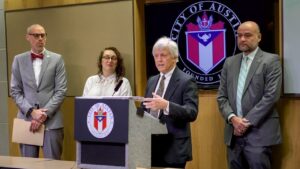 Austin Community Court is a problem-solving, fine-only court with an emphasis on alternative resolutions and providing an immediate connection to on-site Clinical Case Managers, basic needs, and social service resources. The mission of Austin Community Court is to empower people to thrive by providing impartial justice and compassionate community-based services. With more than 25 years of service to the Austin community, Austin Community Court has continuously evolved to meet the needs of the people we serve with creativity and compassion.
Boulder Municipal Community Court – Boulder, CO
Program Contact: Dara Amott
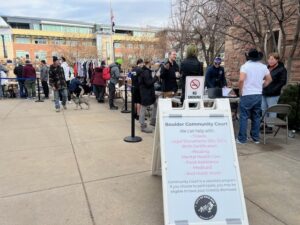 The Boulder Municipal Court’s Community Court Program (CCT) was created in 2020 in response to the revolving door of incarceration and homelessness. It seeks to fundamentally reshape the way unhoused participants interact with the criminal justice system for low-level status offenses. Our goal is to identify the root causes of unlawful behaviors and create individualized solutions with outreach, case management, and wraparound support services. Through this process, CCT provides solutions over punishment, dignity over stigma, and hope over despair.
Restorative Justice Community Courts – Cook County, IL
Program Contact: Margaret Kulujian
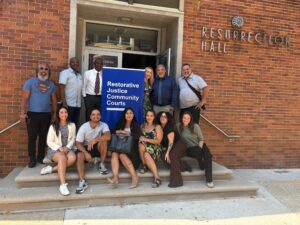 Restorative Justice Community Courts in Cook County, IL offer a healing-centered alternative to traditional criminal justice for eligible young adults ages 18 to 26. They emphasize community involvement, accountability and repair of harm, rehabilitation and reduced recidivism, and reintegration through opportunity and support. By addressing underlying issues such as lack of education, employment or housing, and by involving participants in positive change, the program seeks to prevent future offenses. Successful completion can lead to dismissal of charges and expungement of records, and participants in RJCCs have significantly lower re-arrest rates.
South Dallas Community Court – Dallas, TX
Program Contact: Ninfa Beltran
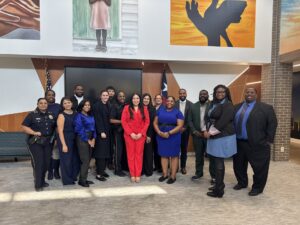 South Dallas Community Courts assist individuals 18 years or older with quality-of-life Class C misdemeanors by providing wrap-around services to systematically address and remove barriers for successful reintegration and restoration of our vibrant community. We have five community courts throughout Dallas, including specialized treatment courts for veterans and individuals facing substance abuse challenges. These courts exemplify our dedication to providing tailored support and interventions while addressing the unique needs of our diverse community.
Spokane Municipal Court – Spokane, WA
Program Contact: Sarah Thompson
Spokane Municipal Community Court strives to build stronger and safer neighborhoods by providing accountability with help for individuals involved in the criminal legal system for quality-of-life offenses. By utilizing a collaborative, problem-solving approach, the Community Court endeavors to hold participants accountable, address factors impacting criminal behavior, provide access to local resources, address victim needs, and increase public confidence in the criminal justice system. Spokane Community Court strives to achieve these goals by building collaborative partnerships within the criminal legal system and among government agencies, social service providers, and community groups.