What New York City’s “pedicab problem” can teach us about delivering justice in today’s world.
If you’ve ever strolled through Central Park on a warm spring day, you’ve seen them.
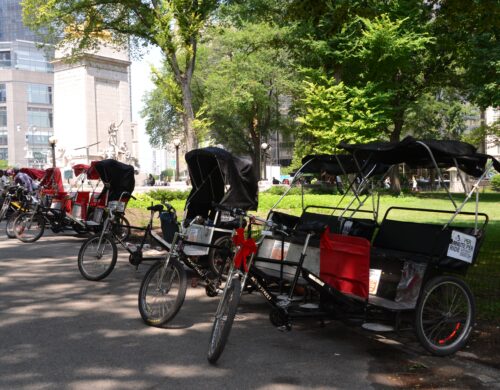
Pedicabs—a New York City fixture. Half bicycle, half carriage, they carry amused families and camera-wielding tourists across the park and around Midtown, often blasting classics like “Empire State of Mind” from speakers.
And they’ve been causing a stir. From pricing fraud to loud music to unlicensed vehicles, complaints about pedicabs have piled up and even made headlines.
Our new roadmap to reform works to change that, proposing concrete steps for reforming the city’s pedicab industry and guaranteeing a safe, fair experience for everyone involved. It’s the result of a roundtable that brought together industry representatives, justice system leaders, and others to map out a path forward.
Reform in the pedicab industry comes with unique challenges, including a complicated regulatory system. But in many ways, the pedicab issue illustrates the broader problems of delivering justice in a fast-paced, complex environment like New York City.
A familiar story
Like all matters of justice, it starts with a complaint. Riders, mostly tourists, are often ripped off, charged hundreds of dollars for short rides with misleading pricing schemes. In 2025 alone, the city’s “311” line received 172 complaints about pedicabs—86 of which were about alleged overcharging.
The costs of these grievances spill out into the wider community. Local businesses lament the damage done to New York City’s status as a tourist destination. Meanwhile, theatergoers and theater owners report blasting music from pedicabs that can be heard even inside performances.
Traditional ideas of justice call for us to assign blame. But the supposed offenders—pedicab drivers—are often caught up in circumstances they have little control over. Many drivers work in conditions that make it hard to follow the law, have few other options for work, and are forced to pay the price for the decisions of those who own the pedicabs they operate.
The justice system, meanwhile, struggles to respond effectively to the realities on the ground. Sporadic crackdowns draw thousands of pedicab drivers into the court system each year. But despite the burden these cases put on drivers, the vast majority of them get tossed away due to logistical issues.
The situation is all too familiar. Disorder puts a strain on individuals and the broader community, sparking calls for a response. But instead of addressing the larger factors at play, the typical approach—policing, court, fines and incarceration—focuses on punishing individuals. The result is either too little or too much: no response at all, or overly harsh responses that put more strain on people who are already struggling.
Community justice enters the scene
More than 30 years ago, the Midtown Community Justice Center (then Midtown Community Court) opened in response to similar patterns. Crime rates—especially for quality-of-life offenses like substance use and shoplifting—were high. But typical responses often left people cycling in and out of the justice system with little change.
The Midtown Community Justice Center took a different approach. Instead of fines and incarceration, it gave people a chance to clear their case in constructive, meaningful ways—community service, drug treatment, job training, and more. The model worked by bringing service providers directly into the courthouse, making it possible to address the underlying challenges that brought people into court in the first place.
The court also hosted community panels, where court staff, residents, local business owners, and people involved in the justice system could get together to workshop solutions to local issues.
That approach is called community justice. In the justice system, it involves bringing everyone to the table and reimagining courts as places that aim to solve local problems instead of simply dealing out punishment.
Our roadmap for reforming New York City’s pedicab industry draws on those same principles. Since November 2024, the Midtown Community Justice Center has seen more than 2,000 cases related to pedicabs. To address the root causes of those cases, we convened a roundtable late last year with community leaders, reformers, city agencies and legislators, and driver representatives.
The road to reform
The roundtable resulted in an eight-step plan for comprehensive reform of New York City’s pedicab industry, created in collaboration with NYC Council Member Gale Brewer, Times Square Alliance, and the Central Park Conservancy.
One core reform involves standardizing prices for pedicab rides across the board. This would help keep riders safe from scams while also protecting licensed pedicab operators from being unfairly undercut by others. It would also mean requiring GPS meters and clear pricing signage to make sure that pedicabs operate with clear, transparent pricing systems.
The plan also proposes holding vehicle owners, not just drivers, accountable for concerns. Drivers can’t always control the condition of the vehicles they operate, including whether seatbelts are working properly or whether prices are clearly displayed. Holding owners accountable isn’t only fairer, it also ensures that resources are directed towards the people who can actually make a difference. And to prevent unnecessary contact with the justice system, the report also calls for supporting fair working conditions for drivers—including safe places to pull over, rest, and use the bathroom.
Other recommendations include straightforward systemic changes—from moving oversight of the pedicab industry from the Department of Consumer and Worker Protection to the Taxi and Limousine Commission, to legalizing safe electrical motors.
A model for justice
Just like it has done since its inception, the Midtown Community Justice Center responded to the pedicab crisis by asking a couple of fundamental questions: What’s at the root of this problem, and who needs to be involved to address it?
As with many issues, the solutions aren’t especially flashy. But they’re the result of consensus among a broad spectrum of people all impacted by the problem in different ways.
Only time will tell which solutions will stick and which may need adjusting. But this roadmap represents a practical path forward to create a safer, fairer future for an industry that has become a staple of New York City’s landscape. And it holds important lessons for how a community justice approach can meet the complex, constantly-evolving problems facing our communities.
Header photo courtesy of the Central Park Conservancy.