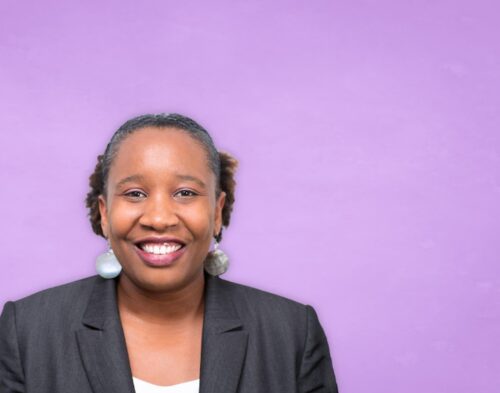
A conversation with Aisha S. Greene on community safety, reducing incarceration, and how to get the research in justice reform to stick.
As a practicing attorney, Aisha S. Greene has spent much of her career working to transform how the justice system responds to crime.
A native of Queens, New York, she has worked in both her home city and across the country to get new approaches off the ground—including in her time at the Center, where she led an effort to help shrink the jail population in Lucas County, Ohio, as part of the MacArthur Foundation’s Safety and Justice Challenge. That work informed our Jail Population Review program in New York, which aims to reduce the number of people awaiting trial in jail by addressing delays in court cases.
We spoke with Aisha Greene about her experience driving reforms, the human cost of jail populations, and how to get the evidence about justice reform to stick.
Could you talk about your experience at the Center helping to reduce the jail population in Lucas County, Ohio? What did that work look like?
We were based in Toledo, and it was a very close-knit jurisdiction. One thing that was really important is the fact that their data is centralized, so we were able to dig deep from a data perspective to figure out where we could work to shrink the jail population.
With the MacArthur Foundation’s Safety and Justice Challenge, the focus was really on looking at how jails were used to detain people. A lot of the folks that were detained, much like in other jurisdictions, were pretrial—folks that have been accused of a crime but have not been convicted. So it was important to think about who was being detained, why, and whether there was a need for that.
All the stakeholders would get together with the data and say, “Is this a case where this person could be released? Can we look at this for early resolution or for an alternative program?” The interventions that the group came up with really worked; I believe they reduced their population by 22 percent and they didn’t see any changes in criminal activity or safety issues for the community.
What do you think are some of the stakes of this work—why should we be concerned about jail populations?
When someone is removed from the community, it may be because there’s a safety concern or a belief that the person will not come back to court to address their charges. Research is really important here because we need to know the factors that actually speak to whether or not that person is going to return to court, or whether they may harm someone else. You don’t want to have a knee-jerk reaction or end up detaining people simply because they’re poor or indigent. Again, a lot of the people that are being detained have been accused of a crime, but they haven’t been convicted.
In Toledo and other places, when you have a building that can hold a certain number of people and it ends up being double that, that is also a safety concern. It’s a safety concern for the people who are being detained and for the people who work there.
We also have to ask, where is the humanity in how we detain people? How do we treat people when they’re being held? There may be medical conditions, behavioral health issues, substance use disorders—and all of those things have to be accounted for.
When you’re trying to tackle a problem like this in a new community, where do you begin? How do you take the first step in such a huge task?
A lot of it is about observing. It’s about saying, “Show me what’s happening here. Talk to me about the pain points, about what’s working or not working. Ideally, what would you like to see?”—while using my experience as a touch point.
It’s really a collaborative process and a co-creation.
The Center comes in with a lot of information at their fingertips—they know how things work across the country and can bring those resources to you. But the approach isn’t just coming in and saying, “We’re the experts, this is how you should do it.” It’s really a collaborative process and a co-creation. The team does its research and will float different ideas. There’s a lot of learning that comes out of it, and then you can take that learning and apply it to other jurisdictions.
How do you think reducing jail populations fits in with community safety?
We know that the overwhelming majority of people who are detained or even convicted of crimes are coming home. So we as a community have to ask ourselves, “How do we want people to come home, and have we made things worse?”
When there’s an incident, we need to ask what happened and what we want to do next as soon as possible. We don’t have to wait until the 400th day after someone has been charged to say, “This person has a substance use disorder and it would be helpful if we put them in programming.” We don’t have to wait that long.
So for me the focus isn’t on reducing jail populations. It’s more about saying, “Where is there inaction on our part? Where are there opportunities that we’re missing?” I think putting that ownership earlier in the process will lead to different results, and one of them may ultimately be reducing the jail population because we’ve addressed a lot of the things that we need to address. I like to look at the problem from the front end rather than the back end.
There’s no shortage of evidence about the harms of incarceration and the kinds of challenges that bring people into the justice system, but it doesn’t always catch on. How do we get that evidence to stick?
I think a lot of it is because the research happens outside of traditional learning environments. Research around neuroscience and criminology should be in our foundational criminal law class that every attorney has to take.
Everybody needs to be prepared to think about innovative ways that we can help our community members.
When you study constitutional law, you understand the trajectory of how things have come to be as far as the law is concerned. But a lot of what we’re talking about is human dynamics, family dynamics. Restorative justice, giving agency back to community—these aren’t requirements, and they need to be. Every prosecutor needs to know why people are coming into the criminal legal system. All of these issues are happening in every courtroom every day. Everybody needs to be prepared to think about innovative ways that we can help our community members, because that is what we’re here for.