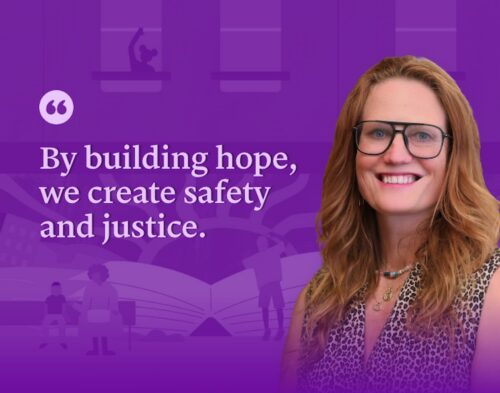
A conversation with Rebecca Thomforde on why addressing intimate partner violence is needed for community justice, how responses have shifted over the past three decades, and what the future of this work looks like.
Leading the Center’s national work to address intimate partner violence (IPV), Rebecca Thomforde has spent much of her career creating multiple pathways to safety and justice that are rooted in the needs of survivors and respond holistically to those who cause harm.
Both locally in New York City and across the United States, that looks like ensuring trauma-informed court responses to IPV, creating restorative and community-based programming, and addressing co-occurring issues in culturally responsive ways—both in and out of the court system—to break intergenerational cycles of trauma.
For Domestic Violence Awareness Month, we spoke with Rebecca, who now leads our Community Justice Solutions team in their approach to addressing intimate partner violence about these pathways to healing and accountability.
Why is addressing intimate partner violence essential for building community justice?
Survivors and people who cause harm are members of our community, and we need to build pathways for their safety and healing so that our communities can thrive. We believe that community safety and justice begins in the home—and for so many survivors, home is the most dangerous place.
Intimate partner violence can be deadly, with intimate partner homicides accounting for roughly 10% to 20% of all homicides nationwide. When survivors and their children aren’t safe at home, the whole community is impacted. Children suffer emotionally, physically, socially, and academically. Many survivors are isolated from community support, including family, friends, co-workers, and religion.
We believe that community safety and justice begins in the home—and for so many survivors, home is the most dangerous place.
IPV also impacts community economic health, due to loss of work from injury or stalking behaviors, medical costs due to injury, and long-term disability. Many survivors stay in abusive homes because they can’t afford to leave, and when they do leave, they often become unhoused, with 38% of all domestic violence victims becoming homeless at some point in their lifetime. Survivors can experience obstacles both when looking for housing and maintaining safe housing, with more than 90% of homeless women having experienced severe physical or sexual abuse at some point in their lives.
Addressing IPV is also a racial justice issue. More than 40% to 45% of Black women experience physical violence, stalking, or sexual violence by an intimate partner in their lifetime—a rate roughly 35% higher than that of white women, and they are three times more likely to be shot and killed by their partners compared to their white counterparts. Because IPV disproportionately impacts survivors of color and intersecting forms of oppression help drive this harm, it is important to center racial justice in our approach.
Through multiple pathways, we can co-design safety and justice that is created with and for those most impacted, beginning with safety in the home.
How has this approach shifted over three decades of the Center?
When I started at the Center 25 years ago, we had just started the first domestic violence court in Brooklyn. We focused on individual accountability for the person causing harm. That looked like court-based responses to accountability through judicial monitoring and abusive partner intervention programming (APIP).
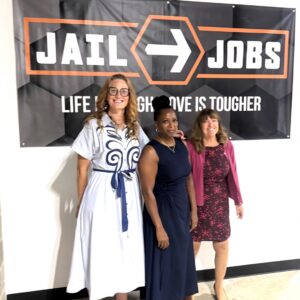
The Center supported the planning and implementation of criminal, civil, and integrated domestic violence courts, as well as sex offense courts in New York State and nationally. This provided access for more survivors to seek safety, accountability, alongside training for court staff on domestic violence, trauma informed approaches, and IPV risk assessment for court and community partners.
Over the years, our approach has shifted in the same way that the Center at large has shifted—toward community-centered responses that innovates within criminal and family courts, while also building out restorative approaches within the community itself. We work across the Center to ensure we are looking both upstream and throughout systems, identifying the intersectional harms of IPV, looking at gun violence, housing access as a safety issue for survivors, centering racial justice, and incorporating restorative practices for both survivors and those causing harm.
Is there a particular moment that stands out to you in your years of work that exemplifies what this work is about?
When I first started, the Center conducted a randomized control study on the effectiveness of APIPS. It showed that survivors really wanted programming, regardless of how successful the research found it to be. That led us to rethink our approach to programming. Through Seeding Generations, we heard from both survivors and people who caused harm about the need for more programming options—restorative, criminal and family court-based, and community based.
Our definition of accountability has expanded into a process to create pathways to responsibility, healing, hope, transformation.
We now look at a myriad of intersecting issues—gun violence, housing justice, racism, trauma, mental health, and substance use—to build out more holistic approaches. Our definition of accountability has expanded into a process to create pathways to responsibility, healing, hope, transformation, and in some cases restoration, in people who cause harm, systems, and communities. This definition allows us to build concentric circles of support and accountability at each of these levels.
Practically, this has seen the Center develop several programs for people who have caused harm: Dignity and Respect is a trauma-informed, culturally responsive class used throughout New York City as part of a criminal disposition. Pre-Trial Relationship Education (PRE) holds a 3-hour class for those with domestic violence related charges under the Supervised Release Program in New York City. Parenting After Violence Education is a class for fathers who have family court cases in which domestic violence is the underlying issue.
Additionally, the Center facilitates community-based and restorative programming throughout New York City for people who have caused harm and programming where there is an overlap with gun violence.
Nationally, we work with communities seeking to enhance their responses to intimate partner violence, whether it’s in the court or in the community at the intersection with gun violence.
You take this work all over the country, and the world, with Community Justice Solutions—what’s one thing you hear in all the places you visit?
We often receive requests for the ‘best.’ The ‘best’ court process, APIP, risk assessment. In an effort to get the ‘best,’ communities often jump to the end of the process. We have found, through our work locally and nationally, that it helps to slow down to ensure that any enhancement is co-designed with those most impacted, and that planning includes both system and community members.
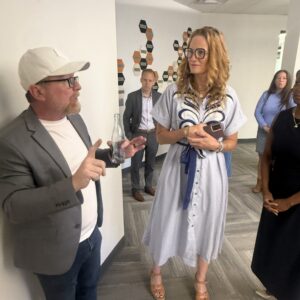
We usually begin by having communities identify the values that drive their work to enhance intimate partner safety and justice. This approach allows communities to identify what is the ‘best them.’ Sometimes that is implementing an approach similar to another jurisdiction; sometimes it is creating an entirely new process to better meet the needs of their community.
This work can often be challenging—what keeps you coming back to create change?
I believe with support, we are all able to make changes to be healthier in our relationships. We incorporate the science of hope into our work that shows us change is possible when we have goals, willpower, and waypower.
It helps to slow down to ensure that any enhancement is co-designed with those most impacted, and that planning includes both system and community members.
By creating multiple pathways, we build hope. And by building hope, we create safety and justice. As Mariame Kaba says, “hope is a discipline. It’s less about how you feel and more about the practice of making a decision every day … It’s a hard thing to maintain. But it matters to have it, to believe that it’s possible to change the world.”
What do you see for the future of this work?
We’re looking at how to better support criminalized survivors, expanding our work at the intersection of gun violence and IPV, creating more restorative and community-based responses, and enhancing court responses to domestic violence when there are co-occurring issues of substance use.
By building hope, we create safety and justice.
I am hopeful that we can continue to expand pathways to intimate partner safety and justice through listening to survivors and better addressing the risks and needs of those who cause harm and that we can break down the silos and barriers to their safety, accountability, and healing.
Looking to learn more about what Community Justice Solutions can bring to your community? Learn more here.