Voices of Justice: Multiple Pathways to Healing from Intimate Partner Violence
A conversation with Rebecca Thomforde on why addressing intimate partner violence is needed for community justice, how responses have shifted over the past three decades, and what the future of this work looks like.
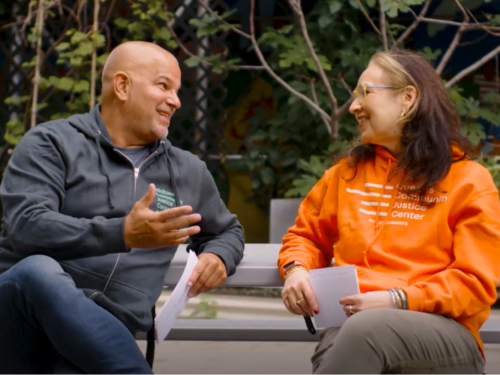
30 Years of Community Justice: James Brodick and Rasmia Kirmani
James Brodick and Rasmia Kirmani sit down to discuss how the community safety landscape has changed, the ecosystem of community justice, and moving at the speed of trust.
According to a newly-released randomized controlled trial, the Harlem Parole Reentry Court has reduced re-offending and improved employment outcomes for parolees returning to Harlem from prison.
Predictors of Mental Health Court Program Compliance and Rearrest in Brooklyn, New York
In this article, mental health court graduation, in-program jail sanctions, and rearrest were tracked for 654 participants in the Brooklyn Mental Health Court. In general, risk factors for negative outcomes included a prior history of arrest or incarceration, having current property charges, current unemployment, homelessness at time of intake, and having a co-occurring substance use disorder. Published in the Journal of Offender Rehabilitation and available here.
New York State’s Integrated Domestic Violence Court Model: Results from Four Recent Studies
This article synthesizes findings from four recent studies examining the integrated domestic violence (IDV) court model. Based on a one family-one judge concept, the New York State court system has established more than 40 such courts across the state since 2001. These courts seek to achieve more informed judicial decision-making, fewer conflicting orders, improved service delivery to victims and their children, and a more efficient and comprehensible case processing system. Published in Domestic Violence Report.
To obtain this synthesis of four recent studies on integrated domestic violence courts, click here.
Domestic Violence Courts: A Multisite Test of Whether and How They Change Offender Outcomes
This article reports findings from an investigation of 24 criminal domestic violence courts across New York State. Overall, the 24 courts achieved a modest positive impact in reducing recidivism among convicted domestic violence offenders. The 24 domestic violence courts also increased conviction rates and sentences involving jail or prison among male domestic violence defendants. Of final interest, court policies specifically designed to increase victim safety, hold offenders accountable, and reduce offender recidivism (through deterrence or rehabilitation) were instrumental in reducing recidivism. Published in Violence Against Women in 2015 and available at the following link: https://vaw.sagepub.com/content/early/2015/06/05/1077801215589231.abstract
The Belmont Revitalization Project: Reimagining an Avenue
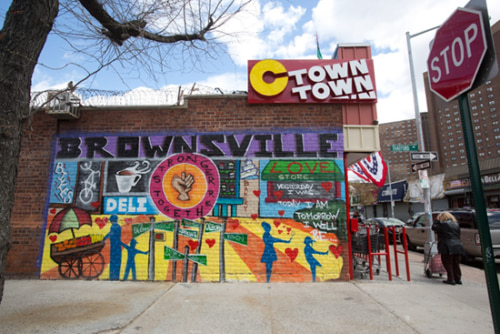
The Belmont Revitalization Project is one of many initiatives being led by the Brownsville Community Justice Center, which seeks to transform the justice system in Brownsville, reduce crime and incarceration, and strengthen public trust in justice by providing alternatives to incarceration and creating opportunities for diversion for youth and community members who come into contact with the law.
Red Hook Community Justice Center 15th Anniversary Celebration
The Red Hook Community Justice Center celebrated its 15th anniversary with a party at the Brooklyn Museum on October 26, 2015. The Justice Center was created to improve public safety, to reduce the use of incarceration, and to improve relations between the justice system and the local community.
Last week, The New York Times ran an editorial, "Bold Plans for New York Courts," describing New York State Chief Judge Jonathan Lippman's vision for justice reform in New York.