Skip to Content

The Arc

Ideas and insights on the future of Community Justice.

Featured Update

Designing Safe Summers

Designing Safe Summers

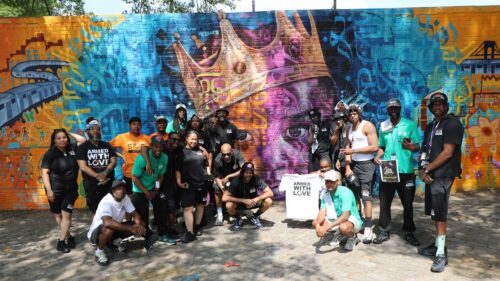
New community-led murals for Gun Violence Awareness Month showcase how art can cultivate safety and connection.

All Updates

Filter by
112 Results
Can Peacemaking Work Outside of Tribal Communities?

Can Peacemaking Work Outside of Tribal Communities?

Peacemaking is a traditional Native American approach to justice. While the exact form peacemaking takes varies among tribes, it usually consists of one or more peacemakers—often community elders—who gently guide a conversation involving not only those directly involved in an offense or conflict but family members, friends, and the larger community.

Dec 15, 2011

Full Faith and Credit and Cooperation Between State and Tribal Courts: Catching Up to the Law

Full Faith and Credit and Cooperation Between State and Tribal Courts: Catching Up to the Law

An article examining the extent to which four jurisdictions offer full faith and credit to tribal court judgments and the role their tribal-state judicial forums have in fostering cooperative relationships between tribal and state court systems. This article was originally published in the Journal of Court Innovation Special Issue on Tribal Justice.

Sep 23, 2010

Treaties, Tribal Courts, and Jurisdiction: The Treaty of Canandaigua and the Six Nations’ Sovereign Right to Exercise Criminal Jurisdiction

Treaties, Tribal Courts, and Jurisdiction: The Treaty of Canandaigua and the Six Nations’ Sovereign Right to Exercise Criminal Jurisdiction

An article exploring the potential uses of Indian nations’ inherent authority and treaties to exercise jurisdiction over non-Indian criminal offenders. This article was originally published in the Journal of Court Innovation Special Issue on Tribal Justice.

Sep 23, 2010

21st Century Indians: The Dilemma of Healing

21st Century Indians: The Dilemma of Healing

An article examining the imposition of Western-style legal jurisprudence and “law” upon Native peoples. This article was originally published in the Journal of Court Innovation Special Issue on Tribal Justice.

Sep 23, 2010

The State of Pretrial Release Decision-Making in Tribal Jurisdictions: Closing the Knowledge Gap

The State of Pretrial Release Decision-Making in Tribal Jurisdictions: Closing the Knowledge Gap

This study examines pretrial release decision-making practices in tribal courts by pulling together evidence from focus group and survey responses, as well as tribal case law. This article was originally published in the Fall 2009 Journal of Court Innovation Special Issue on Tribal Justice.

Sep 23, 2010

Tribal Probation: An Overview for Tribal Court Judges

Tribal Probation: An Overview for Tribal Court Judges

This report provides critical information to tribal court judges about developing and sustaining effective community supervision programs. This article was originally published in the Fall 2009 Journal of Court Innovation Special Issue on Tribal Justice.

Sep 23, 2010

Justice Center Partners with Police to Host Harlem Youth Fair

Justice Center Partners with Police to Host Harlem Youth Fair

On September 17, 2009, the Harlem Community Justice Center, in collaboration with the New York Police Department, held a youth resource fair at the historic Harlem Armory. The fair was the brainchild of Lt. Kevin O’Connor of Patrol Borough Manhattan North, who asked the Justice Center in to help him with the fair. Increasing youth gang violence and the need for parents to know more about the resources available to them in their community were prime motivators for the fair. The name of the fair, “For The Kids (F.T.K),” mirrors the three-letter name trend of many juvenile gangs in upper Manhattan. The fair sent a strong anti-violence message and helped Harlem youth and local police officers interact in a positive way.  Over 1,000 youth and parents attended. They had access to over 80 service providers, recruiters and local businesses with information and give-a-ways. Additionally, youth groups performed for the crowd.  Also in attendance were all the commanding officers for each of the police precincts in Harlem and  Borough Commander Chief Banks III. The Justice Center, working with NYPD youth officers, conducted extensive outreach throughout Harlem to publicize the fair. More than 15,000 flyers were distributed and an email was sent to over 400 partners.

Oct 23, 2009

Harry Belafonte Congratulates Harlem Reentry Court Graduates

Harry Belafonte Congratulates Harlem Reentry Court Graduates

The 10th graduation of the Harlem Reentry Court featured a special guest. “I was born in Harlem, and I grew up in Harlem and now at 82, I’m still in Harlem,” said Harry Belafonte, the singer, actor and activist, as he congratulated the Reentry Court’s 17 graduates on satisfying the program’s rigorous requirements.

Sep 4, 2009

In-School Mediation: Conflict Resolution in a Brooklyn School

In-School Mediation: Conflict Resolution in a Brooklyn School

At New York City’s Middle School 61, high levels of conflict between students—often leading to physical fighting—has been a chronic problem. Over the last three years the Crown Heights Community Mediation Center’s School Justice Center, which works intensively with schools to transform their culture and promote peaceful resolutions to conflict, has offered mediation services to students in an effort to resolve these conflicts. Mediation not only broadens students’ ranges of options, but offers a place where parties in conflict can understand each other. And the confidential and private nature of mediation provides students with a space separate from the pressure of their peers and family members to address the issues at root of their conflicts. Students attend mediation both voluntarily and involuntarily at School 61, depending on the circumstances. Once the Program Coordinator has a referral, she has to determine whether the case is appropriate for mediation and does not pose a serious danger to participants. Appropriate cases include arguments between students, conflicts that may lead to a physical fight, and conflicts that have lingered after a fight has occurred. The Coordinator determines which parties need to be involved in the mediation, what the balance of power is between the parties, and whether or not there is a threat of violence. She gathers the involved students during their lunch period or, if that is not possible, during class time. The mediations are completed either in the mediation office or in an empty classroom if the conflict involves multiple parties. This requires coordination with school deans and also with teachers whose classrooms are being used. During the mediation, the Coordinator encourages all parties to tell their sides of the story. She interrupts behavior that is detrimental to the reconciliation process, reinforces attempts at resolution, helps the students come up with some action steps and agreements, and suggests some tips for conflict resolution the next time a situation should occur. While there are varying opinions about how involved the mediator should be in helping the parties come to their own agreements, the Center’s experience at Middle School 61 over the past three years has shown that an adult mediator in the middle school setting has an educational role, helping students to see and use alternative approaches to conflict. As an educator, the Program Coordinator also uses mediation sessions to help the students recognize how their conflicts escalate as a result of their body language, tone of voice, and choice of words. Once the mediation has ended, the Coordinator sends the students back to class. If they were referred by a teacher or dean, she confirms with that person that the mediation took place. She later follows up with the students privately to confirm that the issue has been successfully addressed and, if conflict still exists, brings the students in for a second mediation. Follow-up continues with the students until they agree that the conflict has ended. As students and staff have seen successes among children of different grades and abilities, and with various disciplinary issues, there has evolved a school-wide understanding that mediation is not only a viable option within the school disciplinary system but also a line of first attack. Today students and teachers unknown to the Program Coordinator approach her knowing not only who she is but also what mediation is. In a school as large as MS 61, this is somewhat extraordinary, and speaks to the fact that the successes of mediation have led participants to discuss their experiences with their peers and elders. Additionally, everyone from the principal of the school to new sixth graders relies on mediation to settle disputes that arise. The result is that mediation has become, in the past three years, a crucial element of the conflict resolution culture at Middle School 61. This form of mediation is a problem-solving strategy that can complement community prosecution and community court efforts—by providing better connections to schools, a focus on enhanced prevention and safety, and robust youth development.  

Aug 3, 2007

Youth Justice Board Presents Recommendations on Permanency Planning

Youth Justice Board Presents Recommendations on Permanency Planning

On June 21, 2007, the Center’s Youth Justice Board presented the results of its year-long study of New York City’s permanency planning process to an audience that included New York City Council members, academics, judges, policymakers, and members of the press. The presentation was hosted by the Administrative Judge of New York City Family Court Judge Joseph Lauria, whose office supported the Board's work throughout the year. Written by the Board’s 16 teenage members—all New York City high schools students 15 to 19 years old, many of whom have been foster children themselves—the report, Stand Up Stand Out: Recommendations to Improve Youth Participation in New York City's Permanency Planning Process, proposes 14 specific recommendations to improve the court experiences and outcomes for adolescents in foster care.   The Board spent several months researching New York's permanency planning process—interviewing over 40 child welfare and court professionals, conducting two focus groups of youth in care and observing Family Court proceedings in Kings County, Bronx County and New York County Family Courts. The report focuses on concrete steps that can be taken by New York City Family Court, the Administration for Children’s Services, provider agencies, law guardians, and by young people themselves to make sure that youth in foster care play an active role in the court process and in the decisions that affect their lives. Stand Up Stand Out: Recommendations to Improve Youth Participation in New York City's Permanency Planning Process is the third report created by the Board, which was launched by the Center for Court Innovation in 2003 as an after-school program bringing together New York City teenagers to study and devise policy recommendations on issues affecting city youth. In its first year, members studied the challenges of youth returning home after confinement for juvenile delinquency; the next year’s group focused on safety problems in New York City high schools. This year’s report has generated even more interest. In addition to the June presentation, the Board will be presenting the report to each of the city’s county courthouses, as well as to several city agencies who have expressed interest. In addition, the New York State Judicial Institute has requested 100 copies of the report to be used at judges’ seminars. Over the next year, the Youth Justice Board will continue to advocate for their ideas and work with Family Court and child protection practitioners to turn their ideas into reality. Watch members of the Board discuss the report on WNBC.  

Jun 22, 2007

Red Hook Photo Project

Red Hook Photo Project

In 2006, the Red Hook Youth Photography Project was developed as a response to community needs in Red Hook, Brooklyn. Over the course of a summer, young people use photography to express their feelings and questions about the world. At the end of the summer, all student portfolios are displayed in a show at the Red Hook Community Justice Center, giving participants an opportunity to be the subject of positive attention from their community. As a geographically and socially isolated neighborhood, Red Hook has struggled with the absence of many basic services and amenities. For example, local youth and their parents have emphasized the need for more arts programs for young people. At the same time, the Red Hook Community Justice Center’s social workers have identified a need for programs that build self-esteem and enable positive forms of self-expression. The Red Hook Youth Photography Project was developed in 2006 as a response to this set of needs. Over the course of a summer, young people ages 14 to 18 use photography to express their feelings and questions about the world in which they live. Program participants are trained in the technical elements of photography—camera operation and care, image editing, and photograph printing—and develop visual literacy by identifying and employing composition, framing, symbolism, mood, and gestures in images. At the end of the summer, all student portfolios are displayed in a show at the Justice Center. The display of their work gives participants an opportunity to be the subject of positive attention from their community, according to James Brodick, director of the Justice Center. Supported by the Edith Glick Shoolman Children’s Foundation, the Youth Photography Project in its first year recruited 10 students to work three days a week for eight weeks. Over the next two years, the program’s capacity will increase to 15 and then 20 students. The program begins with a 25-hour training that teaches youth appropriate workplace behavior, financial management, conflict resolution, and other skills. Participants receive a small weekly stipend that enables them to make a contribution to family finances and helps them begin to implement some of the financial management skills they have learned. In 2006, classes were coordinated by a lead teacher Alice Proujansky and assistant Johanna Neufeld, who have extensive experience in arts education with youth from under-resourced areas. “Sharing and discussing their photographs helps young people develop coping behaviors like positive self-expression, constructive risk-taking, and appropriate social participation, while the photography itself provides an alternative way to communicate difficult emotions and ideas,” Proujansky said. Because some topics may spark challenging and deeply personal conversations, a Justice Center social worker participates in some class meetings and activities, and is available to the participants individually as needed. Each participant also has an individual meeting with the teachers and the social worker to identify any services or programs the young person may want or need and to provide appropriate referrals. The program is designed to have an impact that extends beyond the eight weeks the students spend at the Justice Center. All young people who participate in a Justice Center program have life-long access to the center’s network of partnering agencies and programs, and also become eligible for a variety of services provided by the Justice Center’s Youth Court, including college prep classes and trips, summer internships, and mentoring matches. They also get to keep their digital camera, enabling them to continue their artistic work. To view photos from the 2006 class, click here.

Nov 3, 2006